Are you prepared?

I had just walked out of a 2 year role as General Manager of a $24M a year company. It wasn’t the path I wanted to follow, but it was the only option for me. A few days before, I was asked if I would be interested in attending an introductory seminar for a course in Logistics. “It is only a couple of weeks long,” I was told.

Walking into the room, there were tables set apart with only one chair. We were in the midst of COVID social distancing. The professor explained that this would be a virtual course with occasional face to face meetings on Saturdays. “Two weeks,” I thought to myself.

“How long will this class take?” “It will be 3 nights a week. Four hours each night and every other Saturday for 4 hours.” “OK, but how many weeks,” I asked. “11 weeks, the class is designed to help you pass the CLTD exam,” the professor responded.

11 weeks, times 12 hours a week with alternating Saturdays equals 156 hours of “face” time plus all the prep work which included reading hundreds of pages of text and Case Studies and generating Flash Cards. In the end, over 300 hours of prep, and that was before really studying.

You might think, “I don’t have time for this!” But, in my case, I had time. I was between “things” and with little to take up my time during the day than job hunting. Job hunting is about networking and reaching out to people. Yes, you apply to jobs on-line, but rarely will you get a response unless you find an e-mail address of someone at the Company, and you start reaching out. I will write about that experience another time, but let’s just say that after 6 to 8 hours a day of “hunting” for a job, having 4 hours of class was a good thing for me.

Still, that is a lot of work to get a certificate in a field where I have little to no experience. Sure, I could have said, “no.” “But wait, the class is free,” I could hear the college administrator say. “We have a grant and would normally cost you a few thousand dollars, including the exam fee, will be covered by the grant.”

Wow, that is a great deal, so what about this test? “It is 150 questions, closed book, and you have 3 and a half hours to complete it,” the professor said. He punctuated all of that with a “and it will be difficult for you to finish!”

Great way to start a class! You are going to work your butt off to prepare for a test that is hard to complete in over 3 hours! How does that even make sense? “How many people have this certificate?” I asked. “Less than 1,000 people in the world!” was the response.

“Bring it on!” was the thought in my head.

I won’t boar you with the details, the agony of being brain dead at 10 pm at night after a 4 hour lecture on the crazy world of Logistics! Burnout was a weekly thing, but it did not matter! Needed to be one of the first 1,000 people to get this certificate, so I did the work. I studied, I read the books I wrote the flash cards and took the online quizzes that had me saying, “What kind of question is that! There isn’t enough information to make sense of what is being asked. And the answer they say is the right one makes even less sense than the question.” Weeks went by like that and the closer the test date got, the less prepared I felt.

“I have been studying for months, it is just time to go ahead and take the test! If I don’t pass, at least I will have learned what is on the test and will have a better strategy for studying for the next test.” That is what I kept telling myself for a couple of weeks before the actual exam.

Walking into the testing center – just a quick side note, this was not an office building, it was a small second story office set up with computers and half walls, but that is story for another time – I resolved myself to just focus on each question and ignoring the clock. I was not going to think beyond the current question, I was not going to think about how many questions I needed to get right. I was just going to think about the question in front of me.

I logged into the test. I took the pre-test questions, the kind designed to teach you how to use the testing software. After 10 minutes of “appetizer,” I clicked on “begin” to start the test. The questions were relatively simple at first. “This is just a few simple ones at first to get your confident and then they will slam you,” I thought to myself. As I went through the test, I would flag some questions for review later.

I kept answering questions, flagging about half a dozen in total and then I looked up at the time and how many questions I had answered. In less than an hour I had answered 85 questions. The mathematics did not add up in my head, “How is this possible?” I could not let myself become distracted, I just had to focus on answering questions and after an hour and a half I was done with my first pass. 2 hours left, I went back and looked at the ones I flagged and took my time to study the questions and answer them.

“I can’t just keep reading questions, I know what I know and that is it. I am done with this thing.” That was my last thought before I hit submit. Then I got multiple questions about, “Are you sure you are done?” “YES, I am done!”

The software took a minute to process and then came back with, “Congratulations. It takes 300 points to pass, and you scored 312!” or words to that effect. I had passed! No drama! No crazy questions, just work! No failure, just work. Even if I did not pass, it was just work. I would do it again! And that is the answer to everything! It is just work! If you pass, then you move on to the next test. If you don’t pass, you learn, study, and try again.

Are you prepared? You can’t answer that question until you try and then wait for your results. So, what are you waiting for? Go study, prepare, and then take the test! What is the worse that could happen? You might learn something!

One final thought….

A week before the exam, I was given an offer to join a medium sized Electronics Manufacturer. The role was not one I had planned on, but the company and the people were good, and culture is far more important than role in most cases. I accepted the offer and started the Monday before the exam. Every day I use what I learned in the exam prep class at the company. I did not know it at the time of the interview or when considering the offer, but the weeks of study were not there to prep me for the exam. They were there to prepare me for the role I was taking on!

Life offers you opportunities all the time. We just become blind to them because they don’t match the label or wrapper that we think opportunity comes in and we are often wrong. Take the chance, it may pay off far better than you could ever imagine!
Why we need to learn how to make radio!

You probably have seen pictures of people huddled around a radio listening to the news or entertainment. This was the age before TV, so your imagination had to fill in the “pictures” of what was happening. Families would spend time together listening and discussing what was being said. Children would ask what a word meant, and adults would have to fill in the knowledge gap since descriptions of an object were not part of the broadcast. You did not hear, “you can google that.”

Not too much later, TV makes radio less interesting. There are no pictures in radio, we have to use our imaginations to create the images in our minds. TV gives you sound and moving pictures. It means we don’t have to think too much about what is happening, we can see it. No real explanation of what something is on TV is required because you can see it all.

TV is the shortest path away from boredom for many and that creates a problem for some. Our ability to “see” a solution to a problem is made harder by our lack of imagination. We can’t “see” how something will work unless we have a visual representation of the solution.

I was recently listening to a series of podcasts. One in particular was about revolutions in Iran. I remember the TV images of the students protesting and what was going on at the time, this is in the last 70’s. As I imagine the scene I am struct by a thought, my kids don’t know what this all looks like. Sure, with our smart phones and the internet a quick search will pull down hundreds of video clips of the era and they will get a visual of what happened. But that is not using their imagination, it is not forcing them to visualize what is going on in a place or time.

That made me wonder, are we losing our ability as a species to imagine? Is our modern world and society creating people that only see an App as the solution to a problem?

Most “problems” are “people problems” and the solution to those should be found in the “people” space. Our reliance on machines to solve problems is an evolutionary step, but are we becoming too reliant on the machine doing the work rather than us solving the problem? Our world is become a place where expertise is focused on a very small set of individuals. The 1% situation is not a money issue, it is an imagination and capability issue.

This Blog Post is more posing a question that linking something in the real world to a business. I was listening to a podcast and imagining what people were doing in the audio clip. I was painting a picture of what it all looked like by the descriptions provided and filling in the rest with my imagination and past experiences.

As a builder/carpenter, I am often asked to solve a special problem with a piece of furniture or similar item. In my mind, I visualize the item and then use paper and pencil and later put into CAD form so I can describe the item to others. In many cases, the drawing has to be very detailed for someone to “see” how that cabinet or piece of furniture will “solve” the problem.

I have seen something similar happen in the business consulting space. Most people look for Software systems to solve problems in their business. “Only a computer program will solve this issue,” is what I hear often. The reality, however, is that people and processes are the solution to the “problem” and the machine/computer/software/app is just ensuring that the humans follow the process.

When faced with an issue in any organization, remember that it is people that you are dealing with. Even a robot is waiting for a human to program it, so start with the humans and work your way to the machines. You will find that the solution is far better than starting with the machine and then ending up with the human. We have to refocus our training on developing an imagination and learning radio and how to imagine the scene means in the real world.

It is hard to see the end from here!

Have you ever been hiking or maybe driving in a car through hills and valleys and gotten to a point in the path where you can’t see the end, your destination? Maybe it is because you are at the low point in a valley and your destination is just beyond the next hill? When you get up the next hill you discover that there is another valley and yet another set of hills!

Life can sometimes feel like a never-ending series of valleys, hills and what is beyond. Same goes for Business, “when will this low end and things start to get better?”

There is a statistical theory called “Reversion to the Mean” that states:

“The greater the deviation of a random variate from its mean, the greater the probability that the next measured variate will deviate less far. In other words, an extreme event is likely to be followed by a less extreme event.”

Taken from

https://mathworld.wolfram.com/ReversiontotheMean.html

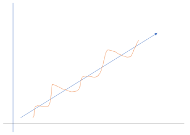
If you take the time to read the full explanation and have the patience for the Statistical Analysis you will reach an understanding that great leaps and bounds are possible, but just because you had a great one the next one probably won’t be as good. See the image below:

Reversion To Mean

The sloped line is your overall growth while the red wiggly line is reality. That is what happens in your business – you grow over time, but some days are better than others. The key is to make sure the line with the arrow is going upwards and is not flat or pointing down.

The key to success in these situations is consistency. You have to keep doing what you are doing the best that you can. That is why so many inspirational/motivational speakers will tell you that the key to your success in habit and ritual and not so much inspiration. Inspiration can get defeated by the lows, the valleys.

If you have ever driven from Palm Springs to Las Vegas – highly recommended drive – you will experience the effect of entering a deep dessert valley. The vastness of the dessert is awe inspiring! Thing is, you are in a car with Air Conditioning. Imagine what it was like for the first settlers with their horses and wagons? The awe was undoubtedly there, but so was the feeling of dread that comes from not seeing or knowing where the end was and how they would survive.

Every business and/or career goes through this, the moment when you see the valley and think, “How will I ever get across this!” Well, just keep going, just keep to the routine. Don’t let the ups and downs give you false hope or dread. Success is just beyond the next hill, but success is not a destination, it is a journey and a discipline, so once you get to it you can stay for a moment and then it will be time to move on….

Switch it up!

Going to share with you a little about what has been going on with me. Don’t worry, I am not going to share my deepest secrets or open up about my emotions. None of those things are bad, but this post is not so much about those things.

-> I started writing a Blog Post each day. I was going to do it for 30 days and then publish my website. I have added a link to my website to a bunch of public posts and linked to my blog posts from a variety of websites, but not much traction. That means it is time to really put it out there. That might mean that someone will give me a bad review or make a nasty comment. Yeah, I have a stalker or two. People who like spending time pointing out my flaws. My publishing won’t stop them, and it may be a great way to confront those hiding away.

Why did I not do 30 posts, one a day for 30 days? I went back to school! I want to get a certificate in logistics, transportation, and distribution – CLTD. There are hundreds of pages to read. Presentations to sit through, 16 hours a week! A test to prepare for – closed book 150 questions and you must get 85% or higher to pass. No pressure! It is not the amount of material to read, but a real focus on learning what I am reading. That takes time. That takes focus and I a not a person that can focus for 8 hours in a day. I have to take breaks.

-> Wood working! I recently videotaped – why do we even still have that word? There is no tape! – myself building a folding hammock stand:

Turns out, the easy part was designing and building the thing! Editing the video was a nightmare. Why? Because it is the first one I have ever done and most of the shots did not have audio so I am doing voice over work and though I have done some of that in the past, not as easy when it is about your own stuff. All in all, a great experience and I will do it again and then again and then some more. There are a ton of projects to do! It is all about sharing how to do things. Yes, I could build kits, and may do that in time, but teaching others is wonderful.

So, I had to learn how to use a video editor – still learning, have not used all the tools or possible tools. And now, I have been asked for drawings with measurements that people can used to build the thing! Not a problem, right? Well, I can’t do a sloppy drawing, it has to be something that other people can read and understand, so it is time to practice with those tools. I took Architecture and Engineering drawing in School, but it was hand drawing, so tools here I come!

Woodworking is a creative outlet. Everyone should have something that pushes their imagination. I also play guitar as a way to let out that part of me that is not all logic and statistics. Woodworking gets them thinking about how things come together and sometimes how to make something out a bunch of sticks. Creating is a power thing.

-> I am between roles and looking for my next one. Notice I did not say job! I don’t want a job! A job is where you trade your time for money, and I don’t want to do that. I want to have a role in a company where I can help others achieve great things. Where I can help the team build whatever it is we are building and create something out of nothing. I want to leave things better than I found them. Money is important, because it is, but it is not the driver of the experience. It is a tool that allows us the freedom to enjoy those things we desire.  

All those things are going on in my life and more, so it has slowed the Blog post a little. But has it? Has that been what slowed it down or is it a priority thing? I would argue that it is a priority thing! I make dinner and have it ready to eat about the same time every day, even with all the other things going on. Why? Priorities! Kids have to eat and 4 nights a week it falls to the older adults (there are a 24, 21 and 17 year old living in this house along with the “older” adults so when I say kids I mean the ones under 25) to make a meal. That meal happens because it is a priority!

And that is what this blog is all about when you really boil it down. What are your priorities? What is that is the most important thing in your day? Is it something that will make your life better today, tomorrow in 5 years? Or is it something to entertain your thoughts and keep you from having to do the really hard stuff like think?

Hope you fill your days with things that will make a 5 year look back feel like a story of change and growth and not a story of repeating the same experiences over and over again just to say you did something. We die once, but we live each and every day! Let’s make sure we never forget that!

Did you really need 10 minutes to tell me that?

Have you noticed that all YouTube Videos are 10 minutes or more now? I do a lot of reading on business and mindset. Sometimes I like going to YouTube to see if there is a video on the 10 best things <blank>, you fill in the blank there. It could be on-line business ideas, or ways to calm the mind, or quotes. 10 things, a short list, right? So why did it take 10 minutes to tell me?

“Nature abhors a vacuum”

“A gas will expand to fill the available space”

Those two quotes, one by Aristotle, are what come to mind when thinking about the bloat of YouTube videos, Marketing materials and e-mail newsletters just to name a few. Since the “bits” are free, why not use more of them up?

A sales pitch is a fine-tuned instrument. It must be just enough to keep the viewer/listener/reader interested, but not so much that they get bored waiting for the punch line.

Books on business is another area that has grown out of control. Yes, the author has a lot of experience and knowledge to share, but 600 pages, really? There is an entire industry now dedicated to summarizing books for busy executives. That seem ironic that an author who used to be or may still be an executive in a company, who is very busy and too busy to read a full-length book decides to write a very long book.

Podcasts! Yes, podcasts are also going the way of bloat. The sponsored ones take so long to get to the actual material that 5 minutes into the list of who “made this possible” I get fed up and stop listening. Yes, your sponsor deserves to be heard, but not to the detriment of the nuggets of wisdom your podcast will impart!

Why? Why do we have to substitute quantity for quality?

OK, so this has been a bit of a rant so far and I appreciate your reading to this point.

Lengthy explanations do not benefit the listener/viewer/reader. Abraham Lincoln is credited with saying that with more time, his speeches would have been shorter and more to the point. I remember hearing that when in school as we discussed the Gettysburg Address, but I could not find a reference to it after doing some quick digging on-line so maybe someone else said it. It is still a good idea to spend more time preparing and less time talking about the topic.

Our goal with communicating is to say just enough to share information, impart wisdom or convince someone to take action. Our goal should not be to overwhelm the receiver of the information. In business, keeping it simple and to the point is usually the best policy.

It is also important to say enough to get the information across. The person listening to you may not know much about the subject so it is best to provide a point of reference or common ground so you can express your ideas and have them land properly. Just don’t take up all that time telling us about 5 people who did not believe it was possible, but now they are true believers.

This blog for example is intentionally short. I keep the postings to 1 and a half pages with that last half usually being a quarter. Why? Because I want to pass on information for those who want to “listen” and if they get curious to learn more, they can just reach out at rick@gramatges.com.

I have been accused more than once of talking too much, so I try to write just enough. If you think it takes a 10-minute video to convince me that these are the 10 best quotes ever, then I would rather you type the quotes in the comments and have me read them. If I can’t understand them, or don’t get it then I will listen to the explanation.

There, less than 1 and a half pages.

The limits of formal education!

I have met many successful people. Some have degrees and others have what some call street smarts. Both bring value and both have limitations and understanding those aspects are the key to success.

 Full disclosure, I have a formal education so this is being written from a point of view held by someone who went through years of “school.” I know a lot of things and one thing I know is how to learn. How to research and how to find out stuff.

OK, so if that is so great, what is up with the title of the blog post. You just said how you have all this education and can go learn things, so what is limiting? The thing about all that learning is that it focuses your thinking along “formal” lines. It is easy to be blind to what is in front of you because it does not conform to what you have been taught opportunity looks like. It blocks you from creativity and can make it difficult to become an entrepreneur.

Someone who did not go through a post High School educational program has had to adapt and learn using their own intuition and, in many cases, their stubborn determination. That stubbornness and belief that you can do something is far more powerful than the thinking that, “I don’t know how to do something so unless I can take a class in it, I can’t do it.” It is unlikely that someone with a formal education would say that to themselves, but many end up there.

If I was not taught how to do it, I can’t/won’t do it!

That is the key phrase that sets up the entire “problem” statement. I was not taught!

In the book, “Surely You’re Joking, Mr. Feynman!” Richard Feynman shares a story about teaching in Brazil. He was excited about the opportunity to work on his language skills and teach classes about physics in a foreign country. If you don’t know, Richard Feynman helped develop the Nuclear Bomb and won a Nobel Prize for his work in Physics.

While working with his students in Brazil, Feynman makes a discovery, they all know the text, they all know the definition, but they do not know what it means. They have not translated the education they have been given into the knowledge they need to move forward in the world. This is frustrating for a man who learned much of what he knows through experimentation and tinkering. There were no books on how to build a nuclear bomb, so Feynman and hundreds of others had to figure out how to do it.

For those of you reading this that have a “formal” education, you should start asking yourself the question, “What do I not see because someone taught me not to look for it?” This question will help you see opportunity where many see problems and will propel you into a world where real problems get solved and things get better.

For those of you reading this that don’t have that “formal” education, well you have your own issues to battle. Mostly the ones about having to figure everything out yourselves. That learning only comes from doing. That is powerful, but it is also exhausting when you can simply pick up a book and learn about what others did to solve the same problem and you can avoid the mistakes they made. A formal education opens you up to a world of knowledge and a way of thinking about what history has taught us and tapping into that can create a short cut to what it is you want.

The beauty of this whole “problem” is that there are lots of solutions. Learning is not limited to school. If you are a lifelong learner, you know that reading and taking continuing education courses are great ways to improve existing skills and learn new ones regardless of your formal education level. The key to success in solving the problem, however, is in recognizing the limiting thoughts that hold you back and where they came from!

That is not the color of the lake!

In his book, “Creativity, Inc,” Ed Catmull goes through the story of Pixar and shares business and life lessons with the reader. In one chapter, he talks about drawing and how artists see the world.

See the world is an important aspect of an Artist’s craft that most people don’t get. They think an Artist draws, but we all can draw. The problem is that when most people draw, they use a pre-defined mental model of what they are drawing to guide them while an Artist uses what they see.

He goes on with several examples, but the one that I thought was really good was about drawing a lake. Most of us, think of water as being blue, so when we go and draw a lake, we make the water blue. Then when you step back and look at the drawing you will likely say, “That is not the color of the lake!”

If you take a sheet of paper and make a pinhole in it and use that to look at a lake, you will see that the lake has browns, greens, yellows, blacks and occasionally there is a reflection of light that is bright white. The Artists sees that naturally, but most of us have to use the pinhole to “sample” the colors and understand that the big picture we see is made up of a whole set of colors that our brains don’t recognize separately.

Even the “white” that we see with the pinhole is not really there, it is a reflection of sunlight, but without it you can’t express that the lake’s surface reflects light. That reflection is something we all see when we focus on it, but it does not make up our “model” of a lake.

This concept isn’t just applicable to lakes or drawings. Most of our experiences in life and how we interact with them are based on a model or framework that our brain builds to help explain the world. If the brain did not do that, every single event in a day would consume us. Imagine having to think about every single step you take to walk to the kitchen. You would never get there! So, the model is a good thing that helps us make it through the day and life, but it can also make us blind to what is really in front of us.

Learning to “turn off” the default mode of your brain is essential for your personal growth and growing your business because it helps your understanding of what is and is not working. Yes, you can achieve a “steady” state of operation where things work and life and the business makes money, but will it stay that way forever? More than likely it will not! At some point you will have to check in on it and make adjustments. Those adjustments can only happen when and if you see where the model is not working and a new model is needed.

That kind of reflection is what separates the leaders of business from the owner that is simply focused on “going to work” every day. If you see your business like a job, the model most people use when describing their daily work, then you will treat it and everyone in it like the typical employee rather than a founder or entrepreneur that wants more than just a paycheck.

Learn to see as the artist does. Learn to see what is there and not be fooled by the model of what you think is happening.

Don’t focus on the trees!

The mind is a bit of a mystery. If you tell someone “not” to think about something, that is the first thing they think about. The title of this Blog came from a talk that Simon Sinek was giving where he wanted to prove to the audience that you can’t have a negative thought in your mind.

Sinek explained that when you are skiing down a slope, through the trees, if you think about the trees, you will hit them. Skiers that don’t hit the trees think about the path between the trees and more or less never see the trees.

The same thing happens when you are watching TV. The minute you start thinking about buying a car, it is as if the advertising world read your mind and started showing more Car commercials.

I want to make it clear here that we are talking TV and not the internet. The Internet knows! I am not joking, there was a lot of research put into how to make sure you see ads for the things you want on Facebook or other platforms.

Did the TV advertisers really do this? Do they know? NO! They don’t, but you are now aware of the commercials where most of the time you ignore them.

Like I said above, the mind is a bit of a mystery, but in this instance, it is a little easier to figure out what is going on after all. Our brains evolved to keep us safe. If we heard a noise in the night, our brains would scan the known set of sounds and come up with a list of potential threats. Once one is identified, you become hyper focused on that potential threat.

You can’t help it. If you hear a noise in the dark, even if it is in your bedroom at night, your mind races to figure out what monster will get you!

Why is this important in business? The business owner has a million things to think about on a daily basis. There are customers to satisfy. There are employees to help. Questions to answer and many more. When the company is small, it is pretty easy to keep most of those things sorted out and get into a rhythm. Once your business gets big enough, however, you can no longer bounce from thing to thing and know where everything is at. You become hyper focused on the “threat.”

“It’s my business, what threat?” you might ask yourself. That noise in the dark that you can’t identify. That feeling that maybe your employees are not doing what they are supposed to do and you have to check on them.

This is why it is so important for all business owners to continuously ask the question, “Is it time to hire management.” Note I said “hire” and not promote someone. I am not going to insist that no one in your organization is capable of being a manager, but most times people get promoted for the wrong reason, they are good at their job. Well, if you take the best employee and promote them, who is going to do their job?

We must focus on the path and not the trees or the obstacles. Bringing someone into the organization that is a positive thinker and will figure out how to grow the business and create room for the owner to do what they are good at is vital. So focus on the positive and what great things will happen with you hire a professional to manage and stop imagining that the tree brushing up against the side of the house is a bear.

For more tips on how to focus on what matters in your business reach out at rick@gramatges.com

“People don’t do what you expect but what you inspect.” Louis V. Gerstner, Jr.

There is a tendency with managers to believe that because they told an employee to do something, that act or task will be completed. I bet you are thinking to yourself right now that the previous statement is crazy. No one ever does what you tell them to do, and I agree, so why do so many keep doing it?

People tend not to do what they are told, not because they want to defy their manager, but because: they don’t know how to do it; it is difficult and there are so many other things to do; they don’t have all the information they need to do it; or lastly, they don’t want to! I am sure you can think of more but let’s stay with these for now.

As a manager, the toughest thing to do is call attention to the fact that an employee is not doing what they are supposed to do. They are not doing the tasks assigned and someone must tell them. Most managers would rather do the work themselves than put in the time to make sure the employee does it. Why? Because it is uncomfortable to face someone and their emotions when you tell them they are not doing their job. Most of us want to be liked and so avoid tough conversations.

How do you overcome this form of procrastination? A lot of times the manager will simply wait till the situation is so bad that their boss, the Director, VP, owner – pick the title – notices and they have no choice, but to act. “I have been covering for you for a while, but now my boss is on me because your work isn’t good enough.” Bet you heard that one more than once! By this time, the employee is so behind that they would rather quit than try and fix what is happening. That is not good for anyone. The conversation is usually emotionally super charged because the manager is angry, and they use that anger to draw the courage to act and have that uncomfortable conversation.

What if we take that situation and change it slightly? It just takes a small change, put a date on it! Yes, just put a date or deadline on the task. “I need you to have the reports on my desk by tomorrow at noon.” Now the employee has a clear understanding of the importance and little wiggle room to get out of the task. As the manager, you now put in your calendar and note at noon for the following day that states you will receive the reports.

OK, so the likelihood of the reports being on your desk is low, in your mind. What do you do when they are not on your desk at noon? You ask, what happened? It is in your calendar, so when the reminder pops up and there are no reports, it should only take a second or two to write the e-mail. Heck, you can write it ahead of time and leave it in your draft folder so you can just click send if the reports were not done.

Now you wait for a response!

If you don’t get one, it may mean that the employee is hard at working getting you the reports and simply has not looked at their e-mail. Good news is you will soon have the information you are looking for on your desk. What if you get one that says, “I am sorry, I just don’t know how to do this?” That is rare, but a great opportunity for you as the manager to coach an employee through a situation and build trust.

What if you don’t hear anything at all after some time? This is likely the worse of situations, the employee is avoiding the question and in many ways you. At that point you could leave it alone and wait for the escalation, or you can simply go by their desk and ask about the reports. This should be a low tension “check-up” and will give you another the opportunity to coach the employee. It is far easier to go at it this way than wait till the tension builds.

What if you still don’t get an answer? Well then it is time for some specific feedback and calling out the fact that not only was the work not done, but the conversation about it was avoided. This employee will need a lot of work and you as the manager will have to decide how much effort to put into it!

Don’t know what is happening with some of your staff? Maybe an outsider can have a conversation and figure it out for you. If you find you are in that situation, reach out and lets talk, rick@gramatges.com.

My Favorite Quotes – Part 1

Someone suggested I write a book of quotes. They like to call them “Rickisms” I just think they are great quotes from some great people. I say Part 1 above because there will likely be a Part 2, but not sure how many more.

“If you think you can do it, or you think you can’t – you are right!” Henry Ford

The man credited with taking the concept of an assembly line and putting it to work making cars. He had a lot of ups and downs before the Model T came out and created the legacy we see today, but this quote is great when you are doubting what is happening. Whatever you think you can do you can make happen, it is in your head.

“It doesn’t make sense to hire smart people and tell them what to do; we hire smart people so they can tell us what to do.” Steve Jobs

Does it make sense to go out and buy a pickup truck and then use your sedan to haul dirt for your lawn? No, right. So why go out and hire people and not give them the opportunity to do what they do best? It can be scary for some, but in the end, it is the best way to get a “return” on your “people investment.”

 “It always seems impossible until it is done.” Nelson Mandela

You never know what you can do until the first time you do it. I am a certified Scuba Diver and the first time I took a breath under water was a freaky sensation. I fought against the notion of taking a breath, but when I finally did it felt amazing! I did not know it could happen, even though I saw others doing it and knew people who had done it, I still did not think it could happen. So, it was “impossible” until I took that first breath. Trust the process, get there, and show the world, and yourself, what is possible!

“Not all readers are leaders, but all leaders are readers.” — Harry S Truman

Among my friends, this quote is used to poke fun at me. You see, I had the CEO of a company mock me and insult me because all I apparently did was tell him the last book I read. Reading is learning and a life dedicated to learning is a full and complete life! All leaders are readers because they are dedicated at making themselves better so they can be better leaders. Don’t confuse “leader” with “boss” because they are not the same. The requirements for being the boss have nothing to do with becoming a better leader!

“It is not the mistakes you make, but what you do to correct or amend for them that defines you!”

I don’t know who wrote that, but it has been one of my go-to quotes for years! I can’t tell you how many people would apologize for making a mistake and go on about how sorry they were and all I would do is recite the quote above. Some people would then go and “fix it,” while others would just look at me as if to say, “I am not going to do anything about this, you need to do it.” You can now see how my opinion of the first person would differ from the second.

“The first time it was a mistake, the second time it was a choice.”

This one is another one that I can’t be sure who said it first, but it goes with the one above it. If you keep making the same mistake over and over again – admit it there is something in your life where this is true – then it is not a mistake/accident or what ever else, it was a choice to be right in the same spot and making the same decisions.

“Easy choices, hard life. Hard choices, easy life.” Jerzy Gregorek

This is a recent one and boy is there a lot packed in there! Yes, I can make the easy choice to stay right where I am in the “comfort” zone, even if it is killing me. One example of this is smoking, we all know that smoking kills. It does not kill everyone, but your chances of dying younger increase when you smoke, so why do we do it? Because it is easier than what it will take to change the habit and make the “hard choice.” It is an incredibly hard choice to make, so I am not mocking people who have the habit, I am just using it as an example.

“People don’t do what you expect but what you inspect.” Louis V. Gerstner, Jr.

Another one that has a lot in it. I would use this one with the owner of a food distribution business all the time because he would complain about his “people” not doing what he asked of them. Why should they? You don’t make them pay any consequences for not following your direction. I am guilty of not following this one, especially with my kids!

Hope you enjoyed reading these. There are many more pulled from the many books I have read and life’s greatest teacher, experience.